
 Get A Quote


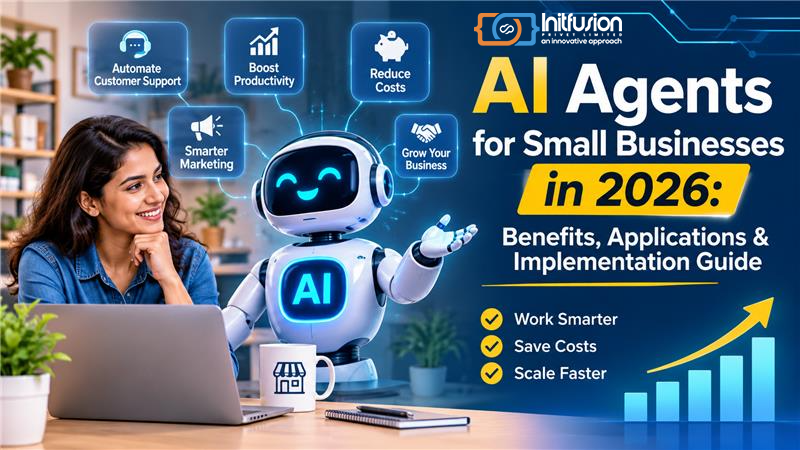
Artificial Intelligence (AI) is transforming how businesses operate, communicate with customers, and manage daily tasks. In 2026, AI agents are becoming an important technology for small businesses looking to improve productivity, reduce operational costs, and stay competitive.
Unlike traditional automation tools that follow predefined instructions, AI agents can understand requests, analyze information, make decisions, and perform tasks with minimal human intervention. From customer support and sales management to marketing and data analysis, AI agents offer practical solutions for businesses of all sizes.
In this guide, we will explore the benefits, applications, and implementation process of AI agents for small businesses in 2026.
What Are AI Agents?
AI agents are intelligent software systems designed to perform tasks, solve problems, and achieve specific business goals. They use technologies such as machine learning, natural language processing (NLP), and large language models (LLMs) to understand information and respond intelligently.
For example, an AI customer support agent can answer customer questions, recommend products, collect customer information, and forward complex requests to human employees.
AI agents can also integrate with existing business applications, helping companies automate workflows and improve operational efficiency.
Top Benefits of AI Agents for Small Businesses
1. Improved Business Productivity
AI agents can handle repetitive activities such as appointment scheduling, email responses, data entry, and report generation. This allows employees to focus on important business activities, planning, and customer relationships.
2. Reduced Operational Costs
Hiring additional employees to manage every business activity can be expensive. AI agents help reduce manual workloads and automate routine operations, making business processes more cost-effective.
3. Better Customer Support
AI-powered customer service agents can respond to frequently asked questions, provide product information, and assist customers around the clock. This helps businesses deliver faster and more consistent customer experiences.
4. Smarter Business Decisions
AI agents can analyze sales information, customer behavior, and business performance data. These insights help business owners identify opportunities, understand customer preferences, and make informed decisions.
5. Business Scalability
As a business grows, its operational requirements also increase. AI agents can manage higher volumes of customer inquiries and repetitive tasks without requiring the same level of manual effort.
Top Applications of AI Agents in Small Businesses
AI agents can support different business departments and industries. Some important applications include:
1. Customer Service Automation
AI agents can answer customer questions, manage support requests, track inquiries, and provide instant assistance through websites and messaging platforms.
2. Sales and Lead Generation
AI sales agents can identify potential customers, collect lead information, qualify prospects, and schedule follow-up meetings. This helps sales teams manage their pipelines more efficiently.
3. Marketing Automation
Businesses can use AI agents to generate content ideas, analyze marketing campaigns, segment audiences, and personalize customer communication.
4. Finance and Accounting Support
AI agents can assist with invoice processing, expense categorization, financial report preparation, and payment reminders. Human review remains important for financial accuracy and compliance.
5. HR and Employee Management
AI-powered HR agents can help answer employee questions, organize onboarding activities, manage interview scheduling, and support recruitment workflows.
6. Inventory and Operations Management
AI agents can monitor inventory information, identify low-stock levels, analyze demand patterns, and help businesses improve supply chain planning.
How to Implement AI Agents in Your Small Business
Successful AI implementation requires proper planning and a clear understanding of business requirements.
Step 1: Identify Business Challenges
Start by identifying repetitive tasks, operational difficulties, and areas where employees spend too much time. Choose a specific problem that AI agents can solve.
Step 2: Define Clear Business Goals
Decide what you want to achieve through AI implementation. Your goals might include reducing customer response times, improving lead generation, or automating administrative work.
Step 3: Choose the Right AI Technology
Select AI tools and technologies based on your business requirements. Consider integration capabilities, customization, security, scalability, and overall cost.
Step 4: Integrate AI Agents with Existing Systems
Connect AI agents with relevant business applications, such as CRM platforms, websites, communication tools, and internal databases.
Step 5: Test and Monitor Performance
Before full implementation, test the AI agent with real-world business scenarios. Monitor its accuracy, response quality, security, and performance.
Step 6: Improve and Scale Gradually
Collect feedback from employees and customers. Make improvements regularly and expand AI automation to other business departments. When the initial implementation delivers positive results.
Challenges of Using AI Agents
Although AI agents offer several advantages, small businesses should consider potential challenges before adopting them.
- Implementation costs: Initial development, integration, and maintenance require investment.
- Data security: Businesses must protect customer and company information.
- Accuracy concerns: AI-generated responses and decisions require appropriate validation.
- Integration complexity: Connecting AI agents with existing software may require technical expertise.
- Human supervision: Important decisions should include appropriate human oversight.
Choosing the right AI consulting and development partner can help businesses manage these challenges effectively.
Conclusion
AI agents are creating new opportunities for small businesses in 2026. From customer support and sales automation to marketing, finance, and business operations, they can help organizations save time, improve productivity, and make smarter decisions.
However, successful AI adoption depends on selecting the right technology, identifying business goals, and implementing solutions that match actual operational requirements.
Small businesses that adopt AI strategically can improve efficiency, enhance customer experiences, and build a stronger foundation for future growth.
