
 Get A Quote

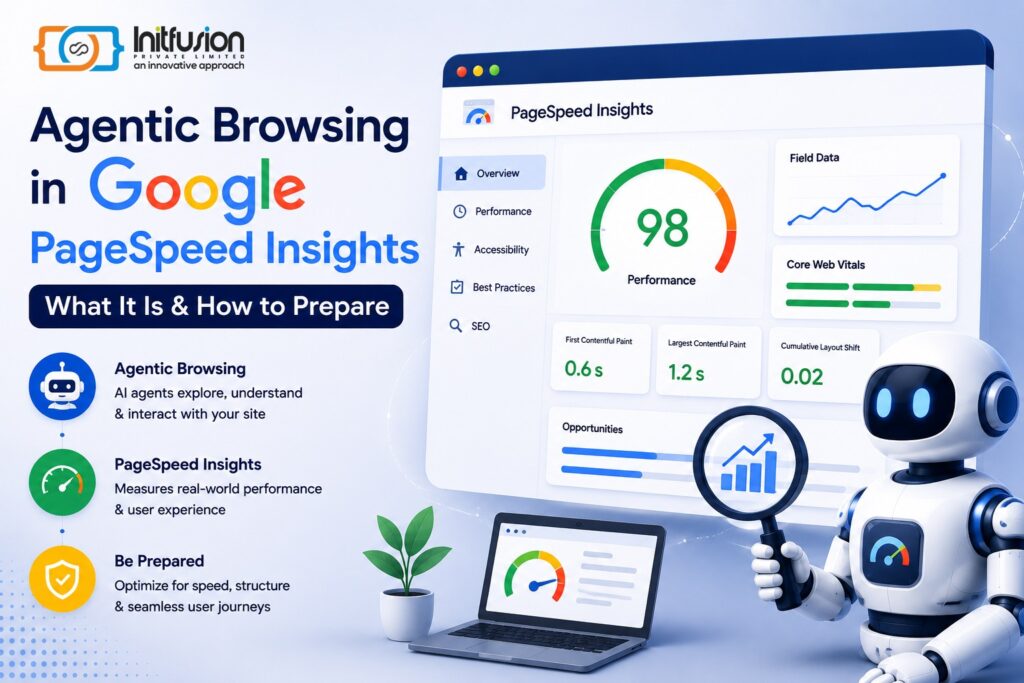
Artificial Intelligence is transforming how people interact with websites. Instead of simply clicking links and navigating pages manually, AI-powered assistants are increasingly capable of browsing websites, gathering information, completing tasks, and interacting with web applications on behalf of users.
This emerging trend is known as Agentic Browsing.
Recently, developers have noticed references to Agentic Browsing within Google PageSpeed Insights, raising questions about what it means for website owners, SEO professionals, and developers.
In this guide, we’ll explain what Agentic Browsing is, why it matters, and how you can prepare your website for the future.
What Is Agentic Browsing?
Agentic Browsing refers to AI agents that can independently interact with websites much like a human user.
Instead of answering questions using stored knowledge alone, AI agents can:
- Browse web pages
- Fill out forms
- Navigate menus
- Compare products
- Collect information
- Complete online tasks
- Execute workflows
Unlike traditional search engines, these AI agents actively interact with websites rather than simply indexing them.
Examples include AI assistants capable of:
- Booking appointments
- Shopping online
- Researching products
- Comparing pricing
- Filling applications
- Summarizing long content
This represents a major shift from traditional web browsing.
Why Is Google Interested?
Google has been investing heavily in AI-powered experiences including:
- Gemini
- AI Mode
- AI Overviews
- Search Generative Experience (SGE)
- Chrome AI features
Agentic Browsing aligns with Google’s vision of making AI capable of completing tasks for users rather than simply presenting links.
PageSpeed Insights appears to be preparing developers for websites that will increasingly be visited and evaluated by AI agents as well as human users.
Why Agentic Browsing Matters
1. Better User Experience
AI agents work best on websites that are:
- Fast
- Responsive
- Accessible
- Easy to navigate
Performance directly affects how efficiently AI can complete tasks.
2. Improved SEO
Google increasingly rewards websites that provide:
- Excellent Core Web Vitals
- Clean HTML
- Semantic structure
- Accessibility
- Fast loading times
These same qualities also help AI agents understand your website.
3. Future-Proof Websites
As AI assistants become mainstream, businesses that optimize today will gain an advantage tomorrow.
Future users may ask AI:
“Find the cheapest laptop.”
The AI agent could browse dozens of websites automatically before making recommendations.
4. Better Accessibility
Agentic Browsing relies heavily on semantic information.
Using proper HTML improves:
- Accessibility
- Screen readers
- AI understanding
- Search engine comprehension
Everyone benefits.
How Agentic Browsing Affects Google PageSpeed Insights
Google PageSpeed Insights has traditionally focused on:
- Performance
- Accessibility
- Best Practices
- SEO
Agentic Browsing introduces another perspective:
Can an AI agent efficiently understand and interact with your website?
That means websites should become:
- More machine-readable
- Better structured
- Easier to navigate programmatically
Key Areas to Optimize
1. Improve Core Web Vitals
Focus on:
Largest Contentful Paint (LCP)
Target:
Under 2.5 seconds
Interaction to Next Paint (INP)
Target:
Below 200ms
Cumulative Layout Shift (CLS)
Target:
Below 0.1
2. Use Semantic HTML
Instead of generic <div> elements, use:
<header><main><article><section><nav><footer>
Semantic HTML helps both search engines and AI understand page structure.
3. Improve Accessibility
Include:
- Alt text
- ARIA labels
- Keyboard navigation
- Proper heading hierarchy
- Descriptive buttons
- Form labels
Accessible websites are easier for AI agents to interpret.
4. Optimize Navigation
Simple navigation helps AI understand your site.
Best practices include:
- Logical menus
- Breadcrumbs
- XML sitemap
- Internal linking
- Clear URLs
Example:
example.com/blog/agentic-browsinginstead of
example.com/page?id=347895. Reduce JavaScript Complexity
Heavy JavaScript can delay rendering.
Recommendations:
- Lazy load scripts
- Minify JavaScript
- Remove unused code
- Use server-side rendering where possible
6. Optimize Images
Use:
- WebP
- AVIF
- Lazy loading
- Responsive images
- Proper dimensions
7. Improve Structured Data
Implement Schema.org markup for:
- Articles
- Products
- FAQs
- Organizations
- Breadcrumbs
- Reviews
Structured data helps AI understand page content more accurately.
8. Make Forms AI-Friendly
Use:
- Clear labels
- Predictable fields
- Standard input types
- Accessible validation
- Logical workflows
AI agents can better complete forms on behalf of users.
Best Practices Checklist
✅ Fast page speed
✅ Excellent Core Web Vitals
✅ Mobile-friendly design
✅ Accessible website
✅ Semantic HTML
✅ Structured data
✅ Logical navigation
✅ Optimized images
✅ Clean JavaScript
✅ Secure HTTPS
✅ XML sitemap
✅ Robots.txt configured
✅ Canonical URLs
✅ Internal linking
What Developers Should Watch
Although Agentic Browsing is still evolving, developers should monitor:
- Google PageSpeed Insights updates
- Chrome Developer announcements
- Core Web Vitals changes
- Search Central Blog
- Lighthouse release notes
These updates may introduce new metrics or recommendations related to AI-driven browsing.
The Future of AI-Powered Browsing
In the coming years, AI agents are expected to handle a wide range of tasks, such as:
- Purchasing products
- Comparing prices
- Scheduling appointments
- Filling forms
- Researching information
- Planning travel
- Managing subscriptions
Websites that are fast, accessible, and machine-friendly will be better positioned to serve both human visitors and AI agents.
Final Thoughts
Agentic Browsing represents the next evolution of the web, where AI assistants actively interact with websites instead of merely indexing or summarizing them. While the feature is still emerging, the best way to prepare is by following proven web development practices: optimize performance, improve accessibility, use semantic HTML, implement structured data, and maintain excellent Core Web Vitals.
Investing in these fundamentals today not only improves your SEO and user experience but also ensures your website is ready for the AI-powered web of tomorrow.
