
 Get A Quote

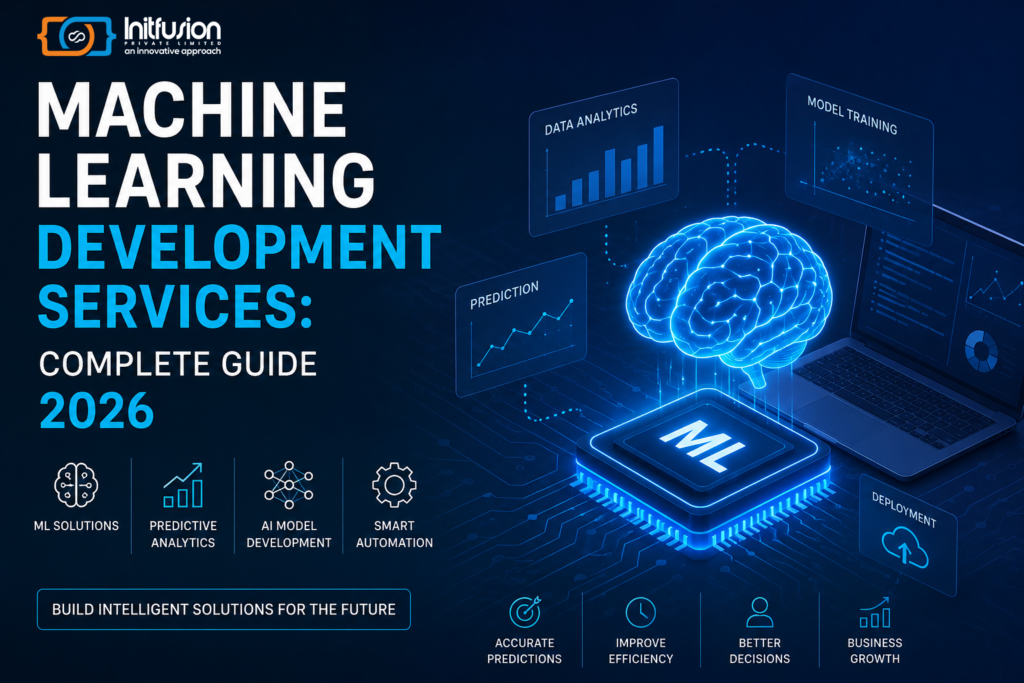
Machine learning (ML) has become a powerful technology for businesses looking to automate processes, improve decision-making, personalize customer experiences, and gain a competitive advantage. From predictive analytics and recommendation engines to fraud detection and intelligent automation, machine learning is helping organizations turn large amounts of data into actionable insights.
As businesses continue adopting AI-driven solutions in 2026, machine learning development services are becoming increasingly important for companies that want to build customized, scalable, and data-driven applications.
In this guide, we explore machine learning development services, their benefits, development process, applications, and why businesses should consider investing in custom ML solutions.
What Are Machine Learning Development Services?
Machine learning development services involve designing, developing, training, testing, deploying, and maintaining machine learning models and applications tailored to specific business requirements.
Unlike traditional software that relies primarily on predefined rules, machine learning systems can identify patterns in data and improve their predictions or decisions as they process more information.
A professional ML development team can help businesses with:
- Custom machine learning model development
- Predictive analytics solutions
- Recommendation engines
- Natural language processing (NLP)
- Computer vision solutions
- Fraud detection systems
- AI-powered automation
- Customer behavior prediction
- Data analysis and forecasting
- ML model integration with existing applications
- Model deployment and monitoring
Why Businesses Need Machine Learning in 2026
The growing availability of business data has created new opportunities for organizations to use machine learning for strategic decision-making.
1. Smarter Decision-Making
Machine learning can analyze large datasets and identify patterns that may be difficult to detect manually. Businesses can use these insights to make faster and more informed decisions.
2. Business Process Automation
ML-powered applications can automate repetitive tasks such as data classification, customer segmentation, document processing, and anomaly detection.
3. Personalized Customer Experiences
Recommendation systems and predictive models can analyze customer behavior to provide personalized products, services, content, and offers.
4. Improved Operational Efficiency
Machine learning can help businesses identify inefficiencies, forecast demand, optimize resources, and reduce operational costs.
5. Competitive Advantage
Organizations that effectively use machine learning can respond faster to market trends and customer needs, helping them stay competitive in an increasingly digital marketplace.
Types of Machine Learning Development Services
Businesses can choose different ML services depending on their objectives and industry requirements.
Custom ML Model Development
Develop custom models designed around specific business data and use cases rather than relying solely on generic solutions.
Predictive Analytics
Predict future outcomes using historical and real-time data. Common applications include sales forecasting, demand prediction, customer churn prediction, and risk assessment.
Natural Language Processing
NLP enables software to understand and process human language. Applications include chatbots, sentiment analysis, document processing, and intelligent search.
Computer Vision
Computer vision allows applications to analyze images and videos. It can be used for quality inspection, object detection, facial recognition, and visual analysis.
Recommendation Systems
Recommendation engines analyze user behavior and preferences to suggest relevant products, services, or content.
Fraud Detection
ML models can identify unusual transaction patterns and help businesses detect potentially fraudulent activities.
ML Model Integration
Machine learning models can be integrated into websites, mobile applications, enterprise software, APIs, and cloud platforms.
Machine Learning Development Process
A successful ML project requires a structured development process.
Step 1: Business & Requirement Analysis
The first step is identifying the business problem, defining objectives, understanding available data, and determining the expected outcomes.
Step 2: Data Collection
Relevant data is collected from databases, applications, APIs, IoT devices, customer interactions, or other sources.
Step 3: Data Preparation
Raw data is cleaned, transformed, labeled, and organized to make it suitable for machine learning.
Step 4: Model Selection & Development
Developers select appropriate algorithms and build machine learning models based on the project’s requirements.
Step 5: Training & Testing
The model is trained using prepared datasets and tested against new data to evaluate its performance.
Step 6: Deployment
Once the model reaches the required performance level, it can be deployed into a production environment and integrated with business applications.
Step 7: Monitoring & Optimization
ML models require continuous monitoring. As business data changes, models may need retraining, optimization, and performance improvements.
Industries Using Machine Learning Development Services
Machine learning is applicable across numerous industries, including:
- Healthcare: Patient analytics, medical image analysis, and predictive healthcare solutions
- Finance: Fraud detection, credit risk assessment, and financial forecasting
- Retail & E-commerce: Product recommendations, demand forecasting, and customer analytics
- Manufacturing: Predictive maintenance and quality control
- Logistics: Route optimization and demand prediction
- Real Estate: Property valuation and market analysis
- Education: Personalized learning and student performance analytics
- Travel & Hospitality: Dynamic pricing and personalized recommendations
Technologies Used in Machine Learning Development
Modern ML development commonly uses technologies and frameworks such as Python, TensorFlow, PyTorch, Scikit-learn, Keras, OpenCV, Pandas, NumPy, and cloud-based machine learning platforms.
The technology stack depends on factors such as the project’s complexity, data volume, model requirements, scalability, security, and deployment environment.
Benefits of Custom Machine Learning Solutions
A custom ML solution can provide several advantages over generic software.
Better business alignment: Models can be designed around specific business objectives.
Scalability: Solutions can be built to handle growing data volumes and users.
Improved accuracy: Models can be trained using business-specific datasets.
Integration: ML capabilities can be integrated into existing software and workflows.
Long-term flexibility: Businesses can modify and retrain models as requirements change.
How to Choose a Machine Learning Development Company
Choosing the right development partner is important for the success of an ML project. Businesses should evaluate:
- Experience in machine learning and AI development
- Industry-specific expertise
- Data security practices
- Development methodology
- Technology and framework expertise
- Model deployment capabilities
- Post-development support
- Scalability of solutions
- Previous projects and case studies
A reliable machine learning development company should be able to handle the complete lifecycle—from data preparation and model development to deployment, monitoring, and optimization.
Future of Machine Learning Development in 2026
Machine learning is expected to become increasingly integrated with generative AI, AI agents, automation platforms, edge computing, and intelligent enterprise applications.
Businesses are moving beyond experimental AI projects toward practical solutions that deliver measurable business value. This makes scalable ML infrastructure, quality data, responsible AI practices, and continuous model optimization increasingly important.
Conclusion
Machine learning development services can help businesses transform data into valuable insights, automate operations, improve customer experiences, and make smarter decisions. Whether a company needs predictive analytics, recommendation systems, fraud detection, computer vision, or a custom ML application, the right development strategy can turn machine learning into a valuable business asset.
In 2026, investing in customized and scalable machine learning solutions can help businesses build more intelligent products and create new opportunities for growth.
